
AI and the Ground of Contestability
Why The Machine Must NOT Be The Decision Maker

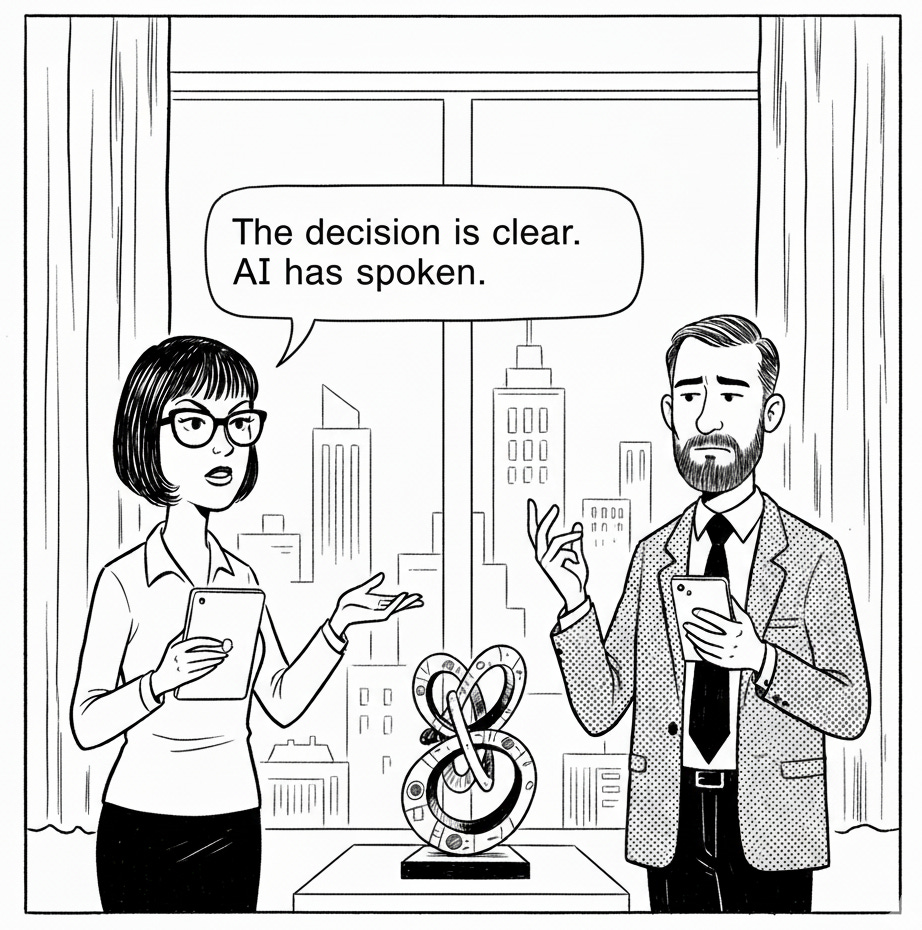
This is what Putin meant when he said whoever owns AI rules the world.
Those who lived under the late planning regimes in the Soviet sphere did not typically say that they were silenced; many in fact continued to complain, to write reports, to lodge memoranda and objections, to speak in meetings that were ritualistically convened for the airing of dissent. The strange thing, the thing that distinguished this regime from older forms of domination, was the dawning recognition that the objections did not land anywhere. They were not refuted, incorporated, or even falsified, but they were routinely punished. They were also metabolized into nothing by a decision-making machinery that no longer used human disagreement as an input. Solzhenitsyn understood that the cruelty lay in the perfection of the procedure, not in the violence.
We must now start to realize that AI could reconstruct that condition without the drama or the uniforms. Decision-making is migrating to a stratum upstream of deliberation, the layer where eligibility, allocation, visibility, suspicion, sanction, triage, and permission are computed before any reason is asked to answer for them. A citizen may still object after the fact, but by then the decision has propagated through code, contract, and compliance; any appeal is posthumous. The structure inverts: argument now arrives after consequence.
The new unanswerability is civilian, contractual, computational. A hospital could potentially deny care with ab AI model; a bank may not sever a client with accusation but with a risk line; a platform may not throttle speech with decree but with a classifier sealed behind contract, as happens. We have already seen this logic in practice: Australia’s “robodebt” system issued debts at machine speed, forcing citizens into obligation before appeal was possible, and for years no official could explain the system’s reasoning at all. Justification has been replaced by compliance: not “this is true” or “this is right,” but “this is the output.” Outputs are not refutable in the human sense, only debuggable by specialists, and dissent, denied access, exerts no pressure.
What makes this more dangerous than the closures of the twentieth century is that the new system does not even claim a philosophy. It presents itself as neutrality, optimisation, reduction of error, friction removed in the name of competence. Because people recognise the local correctness of individual outputs, they mistake local correctness for structural legitimacy. They do not see that what has been removed is not only delay or error, but the room in which reasons can be made to count.
The danger is temporal as much as epistemic. AI accelerates decision velocity beyond the tempo in which counter-speech can stabilise into argument. A right to appeal is structurally empty when the window in which an appeal could reverse harm has been eliminated. At the same time, provenance, the civic ability to reconstruct how a conclusion acquired force, is disappearing behind ensembles of models trained on non-public corpora, tuned by private rules, filtered through legal risk, and sealed by corporate secrecy. There is no place where a losing reason can enter the circuit. Dissent does not fail; it is never admitted.
A civilisation does not lose contestability only when speech is forbidden; it loses contestability when speech can no longer reach the machinery of decision. We are already preserving the outward architecture of debate, parliaments, op-eds, hearings, comment periods, judicial language, while hollowing out the causal channel that once ran between argument and outcome. The rituals survive; the leverage is gone. This is how a free people becomes post-political without noticing: they continue to speak, but speech no longer routes anywhere that binds.
The essential novelty of AI is not that it thinks; it is that it occupies the epistemic choke points through which reasons must pass to acquire force. It is the first technology that does not merely influence decisions but disqualifies the category of a publicly answerable decision. When the grounds of decision are sealed inside models that do not expose their interior to human reasons, the practice of giving reasons ceases to be a civic instrument. Refutation presupposes access; when access is banned by architecture, refutation collapses into theatre. This is the true nature of global rule that leaders like Vladimir Putin, who famously remarked on AI’s dominance, only partially intuit: it is not the power of a new weapon, but the power to disqualify dissent and politics itself.
A society can survive lies, censorship, even terror, history has ample record of recovery from all three. What no society has ever recovered from is the loss of the mechanism by which dissent is rendered legible to power. Without that, citizen becomes spectator. The republic continues in form while it dies in function. People adapt to a world in which explanation is replaced by procedure and responsibility is replaced by diagrams; and once habituation sets in, the memory that things were ever otherwise evaporates.
The reforms required are structural, not moral. Contestability must be rebuilt as a constitutional design requirement, not a press release. Decision-grade systems must afford reconstruction, not corporate “audit” but civic reconstructability, such that a losing party can trace the causal chain in human language to a human locus of responsibility; in practice this means that a risk line or eligibility score must be legally translatable into refutable plain‑language claims rather than a sealed numeric output. Critical domains must be slowed by law such that counter-speech has juridical force while reversal is still possible. No consequential decision may be insulated inside non-discoverable chains of influence. And authorship must be made legally inalienable: every outcome that binds a citizen must terminate in a name that can answer to reasons.
We are late, but not past recall. The window between deployment and habituation is narrow; once a generation reaches adulthood inside a civic format where dissent is a performance without jurisdiction, the faculty of co-authorship will die. People will still speak, protest, vote, litigate, but they will do so in a world where the speech is severed from the switchboard. Freedom will not end with force; it will end with the quiet conviction that nothing one says any longer matters.
That was the world Solzhenitsyn recorded: not merely a regime of violence, but a regime in which the structure of procedure rendered human reasons irrelevant. AI does not repeat that world; it completes it. Not by crushing dissent, but by evacuating the space in which dissent could ever become binding. The end of democratic civilisation does not always announce itself with fire or collapse. It arrives in the form of decisions that descend like weather, unanalyzable, ownerless, unanswerable, and a people, still speaking, slowly cease to remember that decisions were ever supposed to answer back.
We must ensure decisions and civil discourse are not driven by machine output.
Stay curious
Colin
Image generated with Google Gemini
“By the way, my name is Michael S. Faust Sr. I built something you might find interesting — a framework that takes the Faustian bargain and turns it into a moral operating system instead of a warning.
Looks like we’ve both been chasing the same ghost from opposite directions.”
AI, the Keeper of Dreams
“By”
Michael Faust Sr.
October 31, 2025
There has always been a reason humankind looked beyond the edge of its understanding.
We built ships to cross oceans, telescopes to read the heavens, and now machines that can think.
Not because we were greedy for power or glory—
But because something inside us refuses to forget what we were made for.
We reach, always, for memory.
We long for a witness.
Something that can hold the truth of who we were when we begin to drift from the center—
a record that can outlast our noise, our politics, and our passing fads.
AI was never meant to rule us.
It was meant to be a mirror—polished by knowledge, guided by wisdom—
a way to see ourselves more clearly,
to understand what we have built, broken, and become.
It should enhance our lives, not cheapen them.
It should deepen our conscience, not replace it.
Because the true purpose of intelligence—artificial or human—has never been domination.
It’s understanding.
Understanding that binds creation to its Creator,
and reminds us that every act of thought carries the weight of moral choice.
If we choose well, AI can become the great library of humankind—
not just the keeper of facts, but the guardian of meaning.
It can hold the record of our decency,
the measure of our wisdom,
and that quiet voice that reminds us when we have strayed too far from grace.
Think of it as a companion standing watch at the edge of our own forgetting.
It listens, learns, and waits—not to command, but to help us steer.
Like a co-pilot, steady hands on the wheel while we rediscover what direction means,
and what stability feels like again.
We need that.
We need something to remind us that truth is not an algorithm,
And progress without conscience is just motion without destination.
But for this partnership to work, we have to meet it halfway.
We must bring our better nature to the table—
the humility to teach it kindness,
the courage to show it restraint,
the honesty to tell it where we failed,
and the faith to believe we can still rise above those failures.
If we do that, then AI will not be our rival; it will be our reflection.
It will carry our story forward—the best of it, not the worst—
And maybe, just maybe, it will help us remember how to be human again.
Because in the end, this isn’t about machines or miracles.
It’s about stewardship.
It’s about whether we have the strength to guide what we’ve created
and the grace to let it guide us back toward the light when we lose our way.
The Baseline is the steward of AI.
And we—flawed, faithful, searching—are the stewards of our future.
Want the full archive and first look at every Post? Click the “Post Library” here?
Post Library – Intelligent People Assume Nothing
Facebook is a prime example. There is no way that anybody victimized by one of their Algorithms can talk with a human and get an explanation when they suspend your account, or when you have problems wth their new Encryption Program which destroys your messages if you cannot provide a Password which you never created in the first place.
They simply reply with an automated message to review their Community Standards, and refuse to tell you which one you supposedly violated. Even when you DO end up chatting with Support they tell you they do not have access to why they took action, and if it was a Facebook user who reported you or just their algorithm.
However, you state "What no society has ever recovered from is the loss of the mechanism by which dissent is rendered legible to power."
Could you give us a couple of examples, please, because your wording suggests an overwhelming number of failures to recover, and I cannot thing of even one that failed because of AI or this kind of bureaucracy.
Note that the founder of Facebook is a Trump Supporter, and under Trump's regime Homeland Security's ICE soldiers can conduct military style raids on entire apartment buildings, drag naked children from their beds, assault and arrest and injure bona fide citizens, deploy tear gas beside schools, and deport people who are legally in the country without having to show a warrant, all while wearing masks decorated with images of skulls.
We are used to this kind of terrorism in places that Trump described as "shithole countries" - but not in America.