
Chopping Wood
A week off the grid

Well-Being
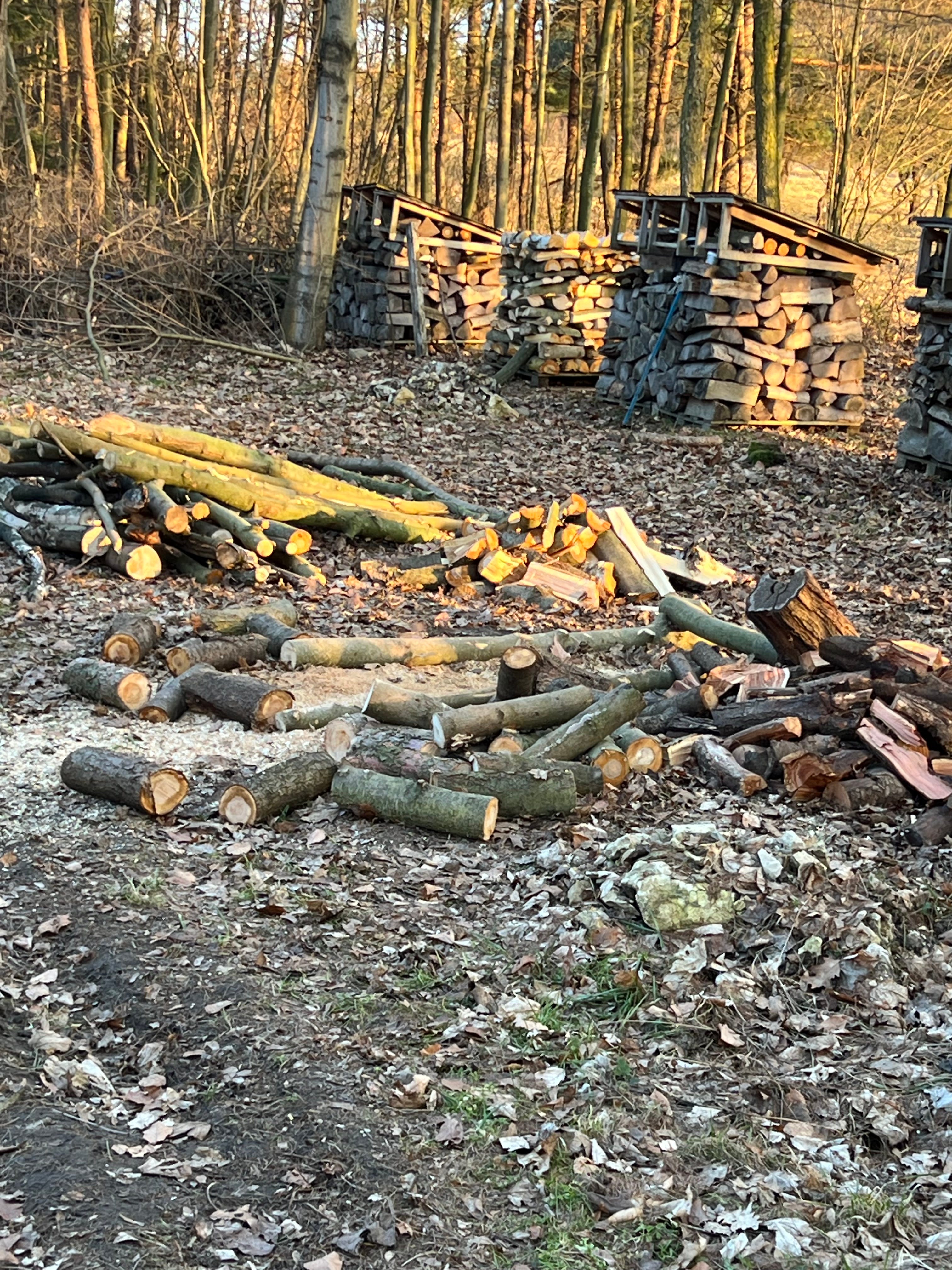
Last week I walked further, and carried more, in five days than I normally do, and by the end of it my mind had become noticeably quieter. I arrived home with hands that did not feel entirely like my own. The skin across my palms had tightened into a rough record of effort. There were shallow cuts and bruises I did not remember receiving, and a heaviness in my shoulders that felt less like pain than like proof. For five days I had worked on a piece of land with my friend, walking close to one hundred kilometres (62 miles), carrying logs, chopping lengths of wood that, depending on the tree (Larch is tough), gave great resistance, hammering together small defensive fences around newly planted trees in a forest full of deer.
It is fashionable, in certain metropolitan circles, to speak about human well-being as though it were a complex engineering challenge. We hold conferences about mood. We publish indices of happiness. We build entire advisory industries devoted to the optimization of the inner life. Yet after those five days I found myself in possession of an inconvenient conviction. I believe that much of what steadies the human spirit is disarmingly simple. Movement. Sleep. Light. Contact with living systems. The ordinary conditions under which our species evolved.
This guidance is ancient. Hippocrates wrote that “walking is man’s best medicine.” Monastic communities structured their days around alternating cycles of prayer and manual labour not only as spiritual discipline but as physiological necessity. They understood something we keep rediscovering and then forgetting. The mind is not an isolated instrument. It is tethered to breath, fatigue, temperature, terrain.
What interests me is not the durability of this knowledge. What interests me is our reluctance to live by it.
Artificial Everything
We inhabit an era of unprecedented environmental control. Artificial light extends the day indefinitely. Climate regulation removes the drama of seasons. Calories arrive through logistics networks of breathtaking sophistication. Experience itself is increasingly mediated through rectangles of glass screens that promise stimulation without friction. I think there is a tragic comedy in this achievement. We have constructed a civilization that behaves as though mood were primarily an informational problem while inhabiting bodies that continue to register reality through effort, darkness, brightness, and proximity to nonhuman life.
During those days on the land I slept with a gravity that bordered on gratitude. There was no negotiation with insomnia, no ritual of late-night scrolling, no subtle anxiety about messages accumulating in distant servers. I would lie down and vanish. I began to grasp what the sleep researcher Matthew Walker means when he writes that “sleep is the single most effective thing we can do to reset our brain and body health each day.” On paper the sentence sounds like a marketing slogan. After hauling timber beneath an open sky it sounds like a clinical diagnosis.
The cheapness of this experiment should disturb us.
Public health systems strain under the cost of treating disorders that are partly environmental. Corporations design elaborate wellness programmes in the hope of coaxing employees toward habits their grandparents practiced without supervision. Governments draft strategic frameworks for resilience. Yet one can alter the texture of consciousness with walking boots and an early night. I do not say this to diminish suffering. I say it to underline a structural absurdity. We have professionalized states that may, in part, be consequences of how we live.
Walking
Friedrich Nietzsche observed that “all truly great thoughts are conceived while walking.” The line is usually quoted as a charming endorsement of intellectual leisure. I think it contains a harsher implication. If cognition is conditioned by movement, then the sedentary organization of modern life may be shaping not only our moods but the quality of our collective judgment. A society that rarely exerts itself physically may also struggle to sustain the kinds of mental endurance required for difficult decisions.
Light governs us with similar authority. After enough mornings in real light, one understands that the body is not persuaded by intention. It is persuaded by conditions. Hormonal cycles that regulate alertness and emotional stability are calibrated by dawn and dusk whether we acknowledge them or not. When we replace the sun with uniform brightness we gain predictability at the cost of synchrony. Seasonal affective disorder, once treated as a northern curiosity, has become an emblem of the tension between biological inheritance and technological ambition.
Henry David Thoreau wrote that “we need the tonic of wildness.” On the fifth day of lifting logs I understood that. Wildness, in practice, is the encounter with realities that do not adapt to our preferences. Wood is heavy. Weather is indifferent. Deer do not respect property lines. To function effectively in such conditions requires attention that is both alert and modest. The mind cannot drift into abstract anxieties while balancing a length of timber on tired shoulders.
There is, however, another layer to our resistance. A status story.
Industrialization liberated millions from brutal labour. This remains one of humanity’s genuine triumphs. Yet the same transformation inaugurated a cultural shift in which physical effort became optional for large segments of the population. Optional gradually became undesirable. Undesirable began to carry symbolic meaning. To sweat unnecessarily in a knowledge economy can appear eccentric, even faintly suspect. We have built meritocratic identities around visible cognitive output. The glowing screen has become a stage on which seriousness is performed.
Rituals
I sometimes wonder whether a portion of modern misery is theatrical. We choose the rectangle of glass over the walking boot not only because it is convenient but because it confirms our belonging to a certain class of worker. Fatigue acquired through spreadsheets signals relevance. Fatigue acquired through chopping wood risks signaling failure. This inversion would be amusing if its consequences were not so widespread.
Charles Darwin walked the Sandwalk at Down House so obsessively that visitors described it as a form of private ritual. Winston Churchill, facing existential war, protected his afternoon naps and time outdoors with near-militant determination. These figures understood that endurance in thought or leadership depends on rhythms that cannot be outsourced. They did not romanticize exertion. They treated it as infrastructure.
Nature offers another corrective. It restores proportion. Urban environments are dense with human intention. Every surface implies a demand. Notifications accumulate like invisible creditors. In forests or fields the hierarchy of urgency rearranges itself. Horizons widen. Minutes stretch. The environmental psychologists Rachel and Stephen Kaplan described this replenishing state as “soft fascination,” a mode of attention gently held by patterns that do not require constant control. Such states rebuild cognitive capacity worn thin by perpetual switching.
Cultivation
While building the small fences against deer I entered a repetitive cadence that felt almost ceremonial. Measure. Hammer. Adjust. Repeat. There was no applause. No performance review. Only the quiet possibility that saplings might survive. And yet an unfamiliar steadiness took hold. Not joy in any dramatic sense. Something closer to equilibrium. A sense that internal turbulence had lost momentum.
William James remarked that “our nervous system is so constructed that it will respond to the habits we cultivate.” Character, he argued, emerges from repetition. Mood may follow a similar logic. Emotional life is partly the residue of physical routine. When routine aligns with evolutionary design, fewer distortions accumulate.
None of this implies that movement, sleep, light, and nature resolve the deepest forms of suffering. Trauma, inequality, genetic vulnerability, and loneliness impose burdens that no amount of gardening can erase. My claim is more unsettling precisely because it is modest. We have underestimated the baseline power of ordinary behaviour. We search for transcendence while neglecting maintenance.
After returning from the land I felt the city’s habits attempting to reclaim territory. Artificial light prolonged the evening into a thin imitation of day. Messages reasserted their urgency. The body resisted, briefly. Then it began to forget. This forgetting strikes me as one of the defining dramas of modern existence. We encounter conditions that restore us, then drift back into arrangements that diminish us, narrating the decline as inevitability.
Perhaps the real challenge is not policy but permission. A cultural reclamation of time. The right to move without justification. To sleep without apology. To step outside before productivity begins its daily audit. These acts are humble to the point of embarrassment, which may be why they are so often postponed.
On the final evening of that week I stood at the edge of the planted clearing. The fences looked fragile. The forest looked endless. I felt tired in a way that carried dignity rather than depletion. Mood, that elusive companion, had become less mysterious. It had also become less negotiable.
Walk further than is convenient. Lie down before the drudgery with your inbox begins. Let morning light reach you without mediation. Stand in places where human intention is not the dominant force. I believe these gestures, small enough to be ignored and powerful enough to be transformative, may shape the future quality of our collective thinking more than any grand reform.
We are not only creatures who plan. We are creatures who recover. A civilization that forgets how to plug itself back into the basic conditions of vitality will continue to design ever more sophisticated explanations for a fatigue that could, at least in part, have been prevented.
I will be back on the fields in mid-April for another week of replenishment.
Stay curious
Colin
Beautifully written and grateful you had this opportunity to open your bustling mind to the beauty of the birds, trees, trails of animals and natural sunlight. Channeling your inner Thoreau restored you. April will reconnect you. We benefit by living a life of intentional balance. Nature shows us so much. Preserve time to explore it and enjoy it.
I appreciate how well you expressed your bone-felt contentment on your week off the grid.
I teach students whose days consist of a screen until sleep, a screen upon waking, a screen at the breakfast table, screen carried from home to car to school to car to home to bedrooms, where some have VR glasses to use. There is no outside moment. Their young experience IS "mediated through rectangles of glass screens that promise stimulation without friction", including the teaching tools at school, where there is less experimentation, less reading, less transmission of knowledge; all their days are via glass screens. And we know the outcome: lack of focus, energy and drive, and more vitally, the cessation of curiosity to learn.
There is a book called, " Last child in the Woods", by Richard Louv, who coined the term 'nature -deficit disorder', a cultural condition. He states that children have become detached from direct contact with nature, and that this loss has deep psychological, developmental, and spiritual consequences.
I live many hours each day in Thoreau's " tonic of wildness” for I am blessed to have close access to walk in wilderness. I understand why organizations fund one week camp wilderness outings for children stuck in lower income regions, who can't afford trips away from the inner city. Undoubtedly, those children's spirits are revived, they experience the connection to what not so long ago was the norm, a rhythm balanced through light of seasons.
From books I've read, less than a century ago, the daily way of life was lived as you did this past week; they felt a " tired that carried dignity rather than depletion." I think this is what our ancestors felt, not so long ago, when they settled a piece of land, and needed to chop the trees, to create a small space to grow, much like you did for the saplings. Every day was carrying water, and chopping wood, and yet, at night there was calm contentedness when all was going well to listen to one sing, another sew, read or play a game. Be assured, I am not nostalgic or weaving a romanticized version of that time, I like heat and running water! But, surely we would benefit from a pendulum swing to acceptance that in our minds and bodies we are still a human who thrives in those ways, for they are beneficial to our body and spirit.
As you said," it is fashionable... to speak about human well-being as though it were a complex engineering challenge." But it isn't a challenge nor does it require complex engineering. It is simple, so simple that lately I've noticed those who can are outdoors, or they are having weekend retreats in the woods, stepping into ice cube baths to revitalize the dormant cells of energy and drive. These trends recognize our need as human living spirits to have Movement that tires us, Natural Light that shines on us and Sleep that provides deep contentment, all condition of vitality for a life well lived.
If, as you wrote, our "cognition is conditioned by movement", and if "the sedentary organization of modern life is shaping not only our moods but the quality of our collective judgment", we need to change the ways young people are living their days, screen to screen to screen without outdoor activity or breathe.