
Humanity's Common Code
The Visions, Contradictions, and Enduring Warnings of H.G. Wells

This is part 2 of a series on HG Wells (Part 1 is here)
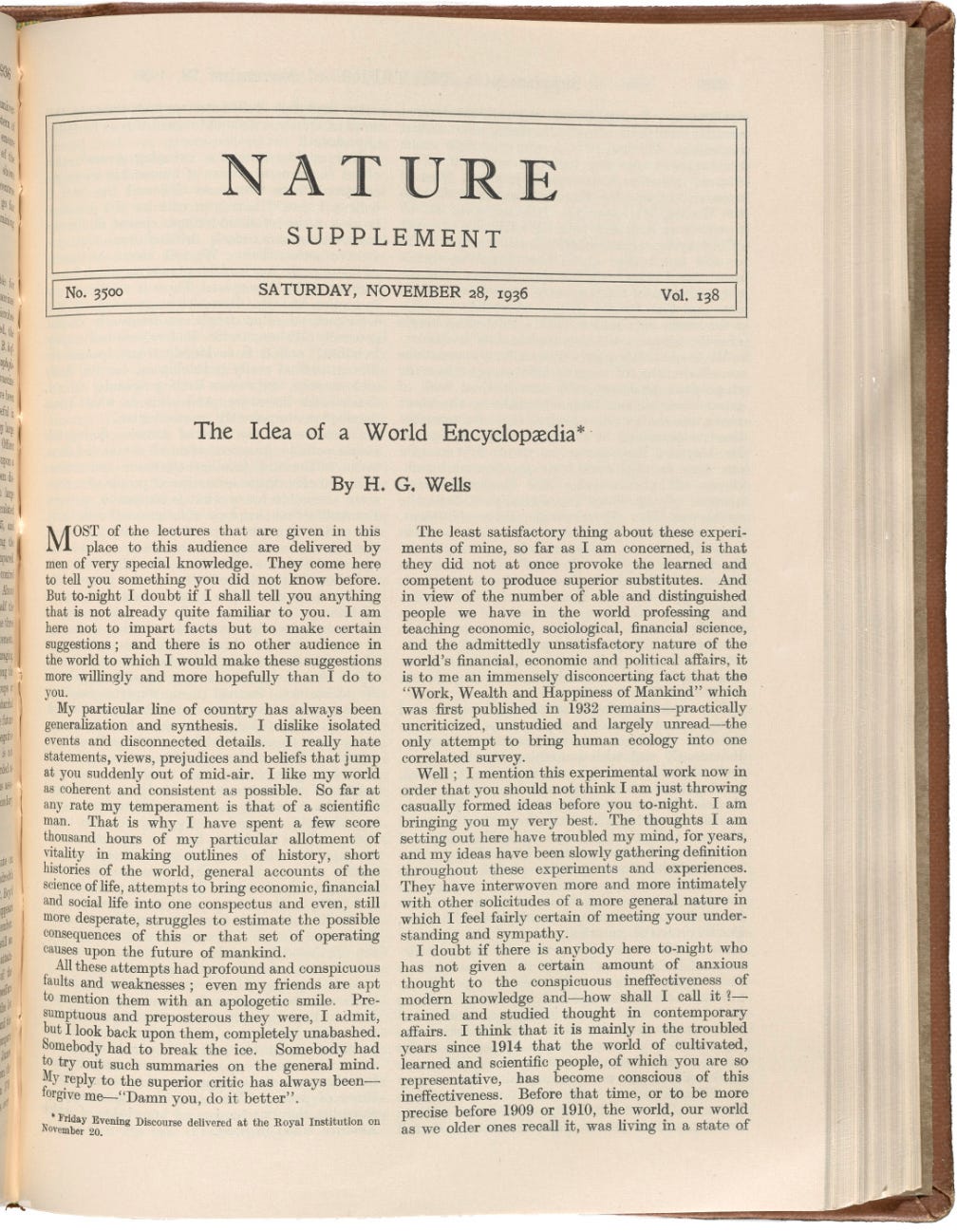
H.G. Wells, thin, asthmatic, electric, did not write to entertain. He wrote to unsettle. A former schoolteacher, who dragged himself out of poverty, with the nervous urgency of a man perpetually five minutes ahead of his era. He saw fiction as a means of foresight. Not the polite allegory of 19th century tea-room literature, but something volatile, fiction that forecast futures, dissected societies, and refused to look away from the gathering dark.
What makes Wells persistently unnerving is not his prescience in the comic-book sense, gadgets, monsters, flying machines, but the unnerving moral clarity with which he extrapolated the consequences. He did not merely guess; he deduced. It’s easy, in retrospect, to marvel at his mechanical imagination: air warfare in The War in the Air (1908), tanks in The Land Ironclads (1903), atomic devastation in The World Set Free (1914).
But Wells’s real gift was not prediction, it was diagnosis. He understood, early and viscerally, that technology was not additive. It was transformative, destabilizing, a kind of metaphysical TNT wired into the baseboards of society. He also produced The Outline of History, a sweeping, audacious attempt to render the human saga as a coherent trajectory, less chronicle, more cautionary tale. It wasn’t just historical synthesis; it was a bid to arm the public with context, to make history a living map for survival.
There is something almost unbearable about reading him now, knowing what we know. As if the script had been handed out in advance, and we still botched the play. He described cities burning from the air years before Guernica, imagined nuclear winter 30 years before Oppenheimer had his Promethean crisis. One sees in Wells a Cassandra complex, but without the mysticism, his visions were grounded, clinical, rendered in prose that cut clean through sentiment of a man who had seen too much of Victorian hypocrisy to be sentimental.
Of course he also dealt in science-fiction. In his enduringly popular 1898 scientific romance The War of the Worlds, the world comes close to being destroyed when Earth is invaded by the Martians, super-intelligent cyborgs with superior technology and a thirst for human blood. Humanity is only saved by the Martians’ lack of resistance to Earth’s bacteria. (I still shudder listening to the music and voice of Richard Burton narrating this masterpiece).
And yet he was, damningly, a romantic. The tension in Wells, the pulse that makes his work still throb with life, is the collision between his intellect and his faith. Faith in progress, in education, in the notion that a better world was not only possible but within reach if we could just behave like grown-ups.
“Human history becomes more and more a race between education and catastrophe,”
…he wrote, in a line that ought to be emblazoned on the walls of every institution with pretensions of stewardship.
His personal contradictions were as vivid as his literary ones. He was a lifelong socialist who carried himself like an aristocrat, a critic of imperialism who couldn’t resist the Empire’s stage, a man who believed in monogamous stability and yet, in a 1913 letter to Rebecca West, confessed without shame or apology:
“I love you—it is as simple as that. And I love Jane too. It is inconvenient.”
The contradiction wasn’t incidental. It was his operating system. But it is in these tensions that we find his genius. Wells did not polish himself into consistency. He was messier, more human. He was trying to save us from ourselves, even as he remained fully, tragically, part of the species he sought to redeem.
This effort reached its most poignant form not in his science fiction, but in his later, lesser-known work, his attempt to formalize the moral architecture of civilization. When the world plunged into the Second World War, another catastrophe he’d long warned about, Wells, then in his seventies, did not retire to laurels or bitterness. He became an architect not of dreams, but of documents. Specifically, he proposed a Universal Declaration of Human Rights. Before Eleanor Roosevelt, before the U.N. Commission, there was Wells and his steadfast typewriter, clacking out what he called “The Rights of Man.”
He chaired the Sankey Committee, where debates were often stormy. he was frustrated at opponents on the committee who objected to including the right to leisure, suggesting that by proposing a future of toil without respite, that is not civilization, it is servitude.
He championed legal definitions for dignity, work, security, health, and education—not as utopian idealisms but as political prerequisites. His 1940 tract, The Rights of Man; or What Are We Fighting For?, became a moral handbook for wartime Britain. He wrote not with hope, exactly, but with defiant necessity. Peace, he insisted, was impossible without shared moral architecture. It is a staggering thing to reflect upon: the man who gave us Martian invasions also fought to secure maternity leave and fair housing.
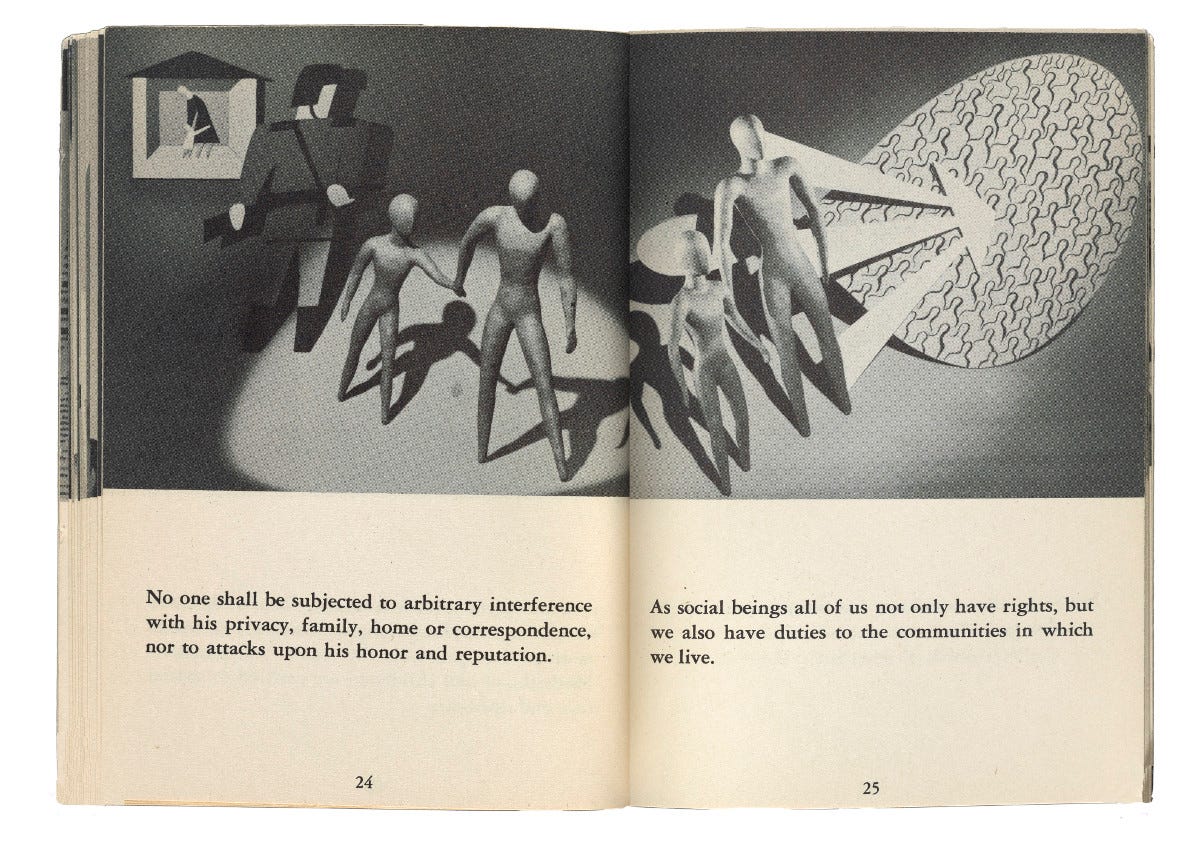
Image from The University of Illinois Library
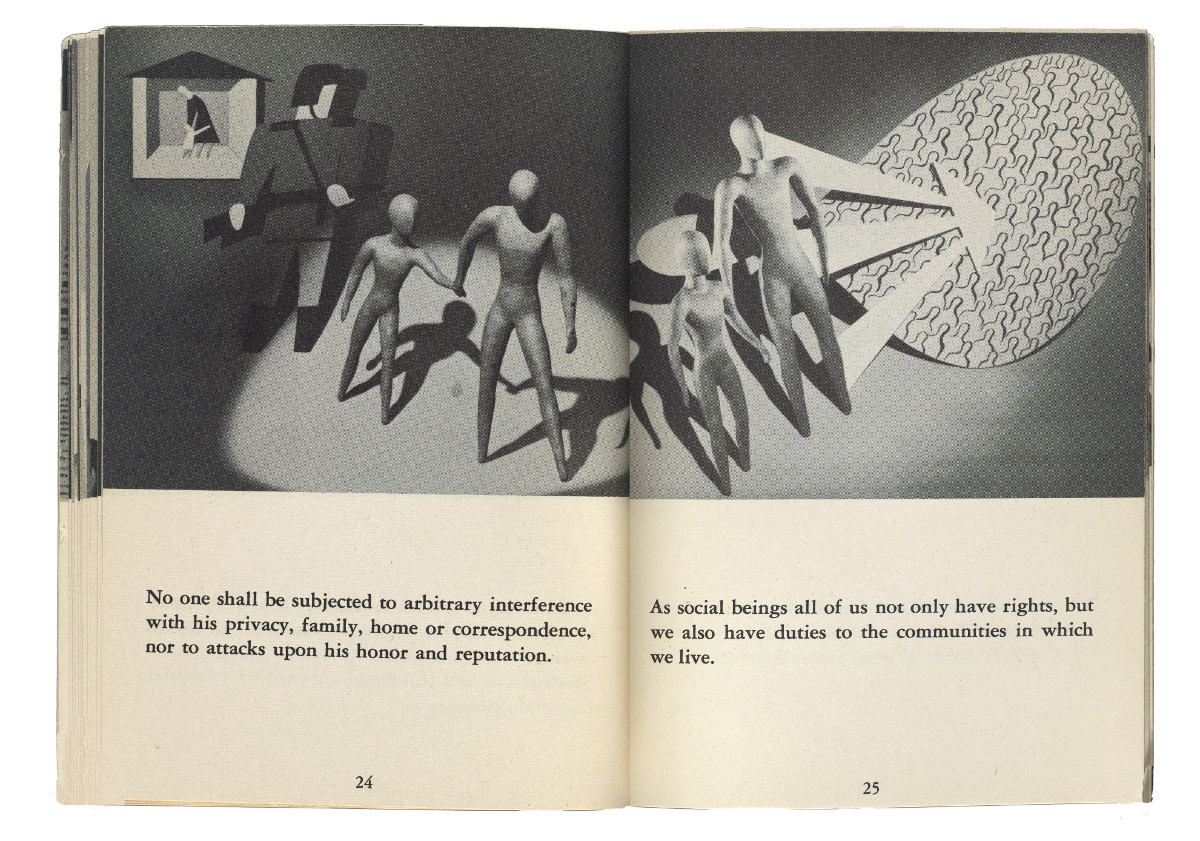
Of course, the final Universal Declaration in 1948 bore the fingerprints of many hands. Wells’s prose was deemed too sweeping, too ideological, too British. But his fingerprints remain, on the concept, on the public discourse, on the possibility that rights could be defined not merely by constitutions or treaties but by the shared, precarious condition of being human. He called it “humanity’s common code,” and it remains, for all its flaws and unenforceability, a north star we glance toward even as we spiral.
Reading Wells now is not comforting. It’s like reading a belated memo after the flood, damage tallied, lessons unlearned, and the ink is still wet with all the things we should have done differently. But it is essential. Because Wells teaches us not only what might come, but what will come, if we abdicate responsibility. He forces us to reckon with the brutal arithmetic of modernity: that for every advancement, there is a social and ethical cost if left ungoverned.
He warns us that every machine we build must be accompanied by a parallel construction: a more robust idea of what it means to live well together.
He remains, irritatingly, right. The race between education and catastrophe is ongoing. The finish line, if it exists, is nowhere in sight. But perhaps that is the point. Wells didn’t expect to win it. He merely demanded that we stop treating collapse as inevitable, that we try, deliberately, doggedly, to prevent the worst from becoming routine.
We should be mindful, not of his fantasies but by his facts, by the persistence of his warnings and the aching durability of his hope. He saw the world as it was, and still wrote for the world as it could be. That, in the end, may be the most prescient thing of all.
Stay curious
Colin
Look at these magnificent sketches from H. G. Wells. ‘When the Sleeper Wakes.’ Illustrated by Henri Lanos. The Graphic, no. 1529 (21 January 1899)
This is part 2 of a series on HG Wells (Part 1 is here)
It seems he exemplified Scott Fitzgerald's quote quite well:
"The test of a first-rate intelligence is the ability to hold two opposing ideas in mind at the same time and still retain the ability to function."
Thank goodness they have not destroyed the libraries and great books...the last refuge of an enquiring mind...so much distraction...