
The Polish Code Breakers
How Three Mathematicians Changed the Way the World Fights in the Dark

The Warsaw Pyry conference of July 1939 is one of the most consequential briefings in modern history.
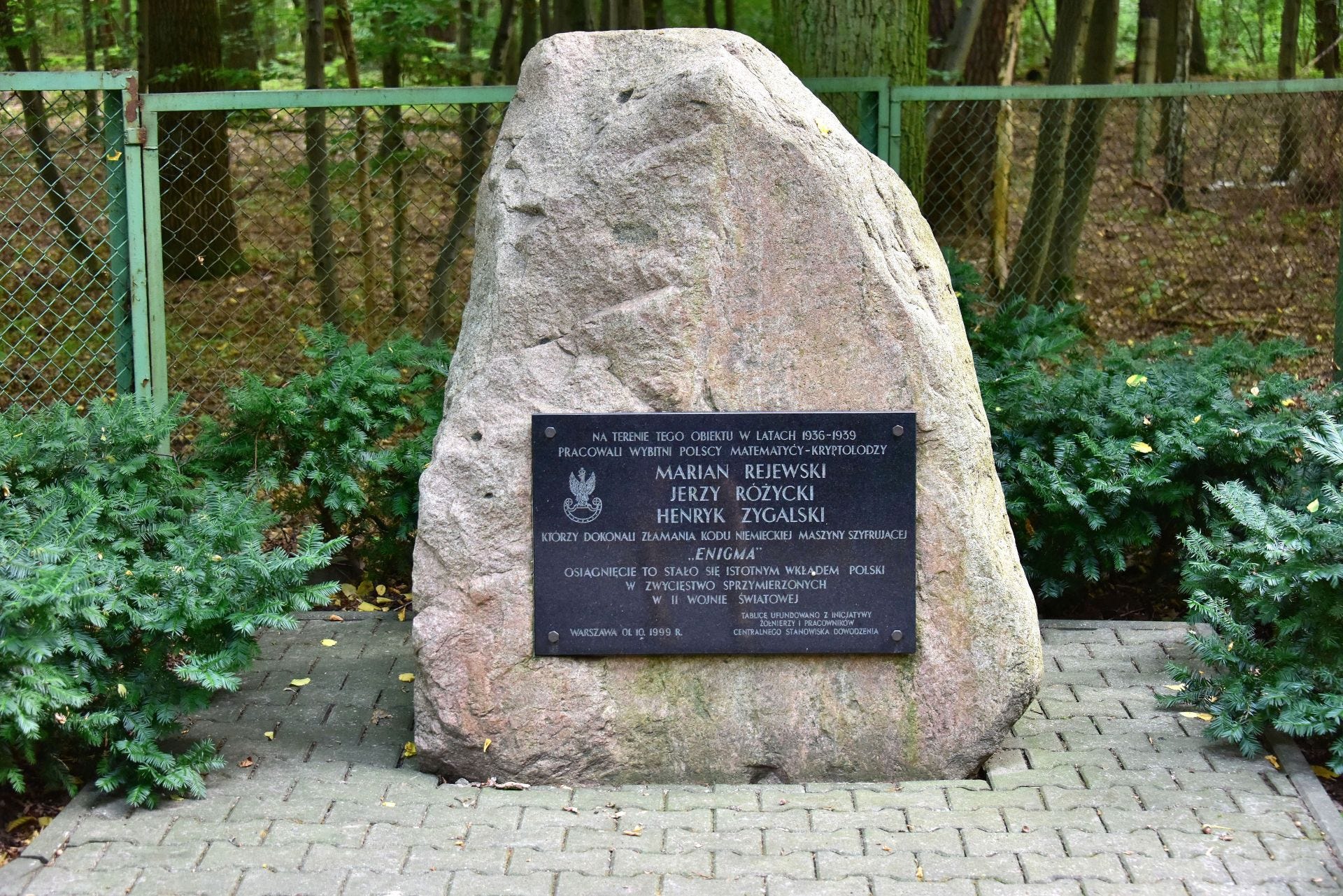
The capital city of Poland, Warsaw, is surrounded by forests, where wild animals still roam; deer, moose, boar, foxes, badgers and a myriad of other small animals and birds. In one of these forests, Las Kabaty, there is a stone monument to three remarkable mathematicians that the world should be aware of, the office where they once worked in that forest, is still operational. But access is strictly limited. I often walk by that monument.
Enigma
In early 1928, a parcel declared as radio equipment arrived at a customs house in Warsaw. It was a Saturday afternoon, and that accident of timing gave the Cipher Bureau employees a luxury rarely afforded in intelligence work: time. They opened the box, examined it carefully, and understood that it was not radio equipment at all but a cipher machine, specifically the commercial Enigma, as the military version was not yet in use. A representative of a German firm demanded its immediate return. The urgency raised suspicion. Officials informed the Polish Cipher Bureau. The box was opened and examined. It contained a cipher machine. It was studied and then resealed.
On July 15, 1928, German military radio transmissions encoded by that machine were intercepted by Polish monitoring stations. Early attempts at decryption failed and were discontinued.
In the same year a cryptology course was established in Poznań for mathematics students fluent in German. On September 1, 1932, three graduates were recruited to the Cipher Bureau in Warsaw: Marian Rejewski, Jerzy Różycki, and Henryk Zygalski. The Bureau’s leadership, including Maksymilian Ciężki and Franciszek Pokorny, directed work toward systematic analysis of German ciphers.
By the early 1930s, the German Enigma machine, based on rotating electrical rotors, had entered military use, offering a large number of possible configurations through rotor order, ring settings, and plugboard connections.
The historical foundations are firm. While the details of espionage often shift or blur, the timeline here remains stable. The identities of the men and the architecture of the machine, the rotors, reflectors, and light panel, are the fixed coordinates of this story. These are not merely data points but the physical reality that the Polish mathematicians had to translate into logic.
Simply put, we should move away from the temptation to treat this as a technical prelude to a British story. Dermot Turing’s (nephew of Alan Turing) account, in his wonderful book X, Y and Z – The Real Story Of How Enigma Was Broken, is careful, almost corrective in tone, and for good reason. The British achievement at Bletchley Park stands on a prior act of intellectual audacity that did not occur in Cambridge or London, but in Poznań and Warsaw. The order of events is not a matter of national pride. It is a matter of causality.
Humble
What strikes me, reading Rejewski alongside the later narrative by Turing and others, is the humbleness of the Polish intervention. There are three young men invited into a room and asked to look at a machine as if it were a poem or a puzzle of symbols. This was the hinge. While others saw a terrifying wall of gears and electricity, Rejewski and his colleagues saw a system of relations. They moved the struggle away from the hardware and into the realm of human thought, deciding that even the most complex machine is ultimately a reflection of the mind that built it.
Their method, grounded in permutation theory, did not break Enigma by force. It reduced it. That is a different intellectual gesture. To reduce is to deny the machine, or system, or methodology, its authority. It is to say that the apparent randomness is, in fact, organized.
The breaking of the Enigma code story is unexpectedly positive. Not triumphant in the usual sense, but instructive. A small group, operating with limited resources, chose a different way of thinking. Ciężki’s decision to recruit mathematicians was described later as unusual, even suspect, by foreign counterparts. Even after the July 1939 meeting at Pyry, Alastair Denniston, head of the British Government Code and Cypher School, argued that physicists were preferable because they retained what he called a “contact with reality.” The Polish wager was the opposite.
Two devices mark the transition from insight to operation: the cyclometer and the bomba kryptologiczna. These devices did not emerge in isolation. They depended on a close working relationship between the Cipher Bureau and the AVA Radio Manufacturing Company, particularly engineers such as Antoni Palluth, who could translate mathematical insight into functioning electromechanical systems. These were not acts of surrender to machinery. Rejewski himself regarded the turn toward electromechanical assistance with some reservation, almost as a concession. Yet those devices extended the initial insight. They made it operational.
Reconstructed Machines
Dermot Turing’s narrative shows how this initial insight migrated. At Pyry in July 1939 the Polish team provided reconstructed Enigma machines and explained their methods in detail, effectively handing over both the tool and the conceptual framework. The British bombes were descendants, not independent inventions. The Pyry conference of July 1939 is one of the most consequential briefings in modern history. The Poles did not merely share results. They transferred a way of seeing.
The accounts of that meeting reveal the human texture. The irritation felt by the French and British was not incidental; it was rooted in long traditions of earlier success that had failed against a machine cipher. Dillwyn Knox, one of the leading British cryptologists, was so unsettled by the Polish achievement that he initially suspected they must have obtained the internal wiring of the machine illicitly, a suspicion that would later echo in years of confused and distorted retellings. Irritation, disbelief, wounded pride. French expectations of reciprocity. British confidence in their own tradition. These are not flaws in the story. They are its substance. Knowledge moves through people, and people carry habits of thought that resist displacement.
Bletchley Park
The standard version of this history often rushes past the Polish contribution, treating the Pyry meeting as a mere handoff before the real work began at Bletchley Park. This framing suggests that Alan Turing simply picked up where Rejewski left off, but that version of the story flattens a much deeper technical evolution.
The shift was not just about scale; it was about a change in how the battle was fought. Rejewski’s initial breakthrough relied on finding patterns in the way the Germans repeated their message keys, a method based on pure mathematical symmetry. By the time the work moved to England, the Germans had changed their procedures, forcing a new approach. The British bombes were indeed descendants of the Polish machines, but they were repurposed to hunt for cribs, small fragments of suspected plain text, like weather reports or military greetings.
This was not a simple handoff. It was the migration of a fundamental insight into a new operational reality. To see the Polish work as a mere opening act is to miss the truth of the lineage. Their achievement was the conceptual engine. Without that original Polish framework to build upon, the later industrialization of codebreaking would have been a search without a map.
Structured Analysis
The Polish move toward abstraction was not simply intellectual elegance; it was born of constraint. While the French possessed valuable intelligence material obtained through Hans-Thilo Schmidt, these documents were originally deliberately kept away from the Polish mathematicians. The result was a forced independence: the problem had to be reconstructed mathematically rather than solved through espionage. This decision sharpened the method and ensured that the eventual breakthrough rested on structure, not on accident. The Enigma problem, as presented by the Germans, was a problem of scale. Large numbers, many configurations, operational discipline. The Polish response was a problem of form. Identify invariants, exploit repetition, model the machine as a system of permutations. This is not merely a historical curiosity. It is a lesson in how intelligence proceeds when faced with overwhelming complexity.
I believe we are drawn to stories of scale because they are visible. Rows of machines, large facilities, vast expenditures. But the decisive movement here is almost invisible. A change in representation. A refusal to accept the problem on its given terms.
The precursor to AI?
The transition from pure human logic to mechanical assistance in Warsaw can be viewed as an early precursor to the logic of automated intelligence. When Marian Rejewski realized that the human mind could no longer keep pace with the Enigma’s permutations, he did not simply build a faster calculator; he designed the bomba kryptologiczna to automate a specific process of logical deduction. This shift, moving from solving a problem manually to designing a system that can reason through millions of possibilities based on a set of mathematical rules, is the conceptual ancestor of AI. It represents the moment when human insight was first offloaded into a machine to solve a problem of scale that was otherwise impenetrable to organic thought.
Saved Lives
There is a claim that appears in almost every serious account of the breaking of the Enigma Code. That the decryption of Enigma shortened the war by two, perhaps three, even four years, and in doing so saved millions of lives. The number varies depending on the historian and the counterfactual they are willing to entertain, but the direction is consistent. Intelligence derived from Enigma, what the British later called Ultra, altered convoy routes, exposed troop movements, and compressed decision cycles at the highest levels of command. It did not win the war alone, but it changed its duration and its cost in human lives.
The positive image that remains for me is not Bletchley’s halls or the machines in motion. It is in two smaller rooms, one in a forest on the outskirts of Warsaw, the other at the Nazi destroyed Saxon Palace, the Cipher Bureau's headquarters before the move to the forest, a blackboard, a set of symbols, and three young men who decide that a machine built to conceal can be rewritten as a set of relations. That decision, taken early and held with discipline, carries forward through the war, through the later machines, and into the quiet architecture of modern computation.
Cyber Warfare
Poland is still at the leading edge of cyber work. The war in Ukraine has led to regular cyber attacks, by Russia, Iran, North Korea and others, on Polish companies, institutions and infrastructure. The groundwork laid by the three mathematicians survives in the local expertise that remains a primary defense against modern digital aggression. In Warsaw, Krakow, Poznań and other Polish cities, the lineage of Rejewski, Różycki, and Zygalski is not a static memory but an active methodology. When Polish engineers today encounter encrypted threats from state actors, they are operating within a tradition that prioritizes the structural over the superficial.
The current landscape of cyber warfare involves a challenge that is similar to the Enigma problem, yet the Polish response remains as ironclad as it was before the second world war: the belief that any system of concealment is ultimately a system of logic that can be unraveled through mathematical rigor. The stone monument in Las Kabaty serves as a reminder that the most formidable defenses are not built of steel or vast servers, but of the intellectual courage to look at a machine and see an equation.
This continuity suggests that the greatest legacy of the Cipher Bureau was not just the messages decrypted or the years saved, but the establishment of an intellectual infrastructure that still guards the frontier of European cyber security. The three young men in the forest did more than break a code; they proved that a small, disciplined group using abstraction as a lever can shift the weight of the world. In the silent rooms where modern threats are analyzed today, their way of seeing remains the most effective tool for defending against the attacks of modern warfare.
Stay curious
Colin
Your post reminded me of the following:
The past, after all, is not just a graveyard of disasters. It is also a reservoir of hope. I have always been fascinated by those small groups of stubborn people who change the course of history. Sometimes for the worse, think of the Bolsheviks, but also, gloriously, for the better. Florence Nightingale and the nurses who pioneered evidence-based medicine. Emmeline Pankhurst and the suffragettes who won the vote for women. Norman Borlaug and the inventors whose Green Revolution saved millions from famine. What all these people had in common was a clear vision, a scalable strategy, and the unflagging persistence to pursue their goals. In the immortal words of Margaret Mead, “Never doubt that a small group of thoughtful, committed citizens can change the world. Indeed, it's the only thing that ever has.”
https://downloads.bbc.co.uk/radio4/reith2025/Reith_2_R4_2025_Transcript.pdf
The final point of this post really stayed with me. I don’t claim to understand the nature or pace of AI development, but it leaves me wondering whether our understanding of these systems is keeping up with how quickly we’re building and using them.