
The Shared Walk
A Reflection on Jim Holt’s Excursions to the Edge of Thought

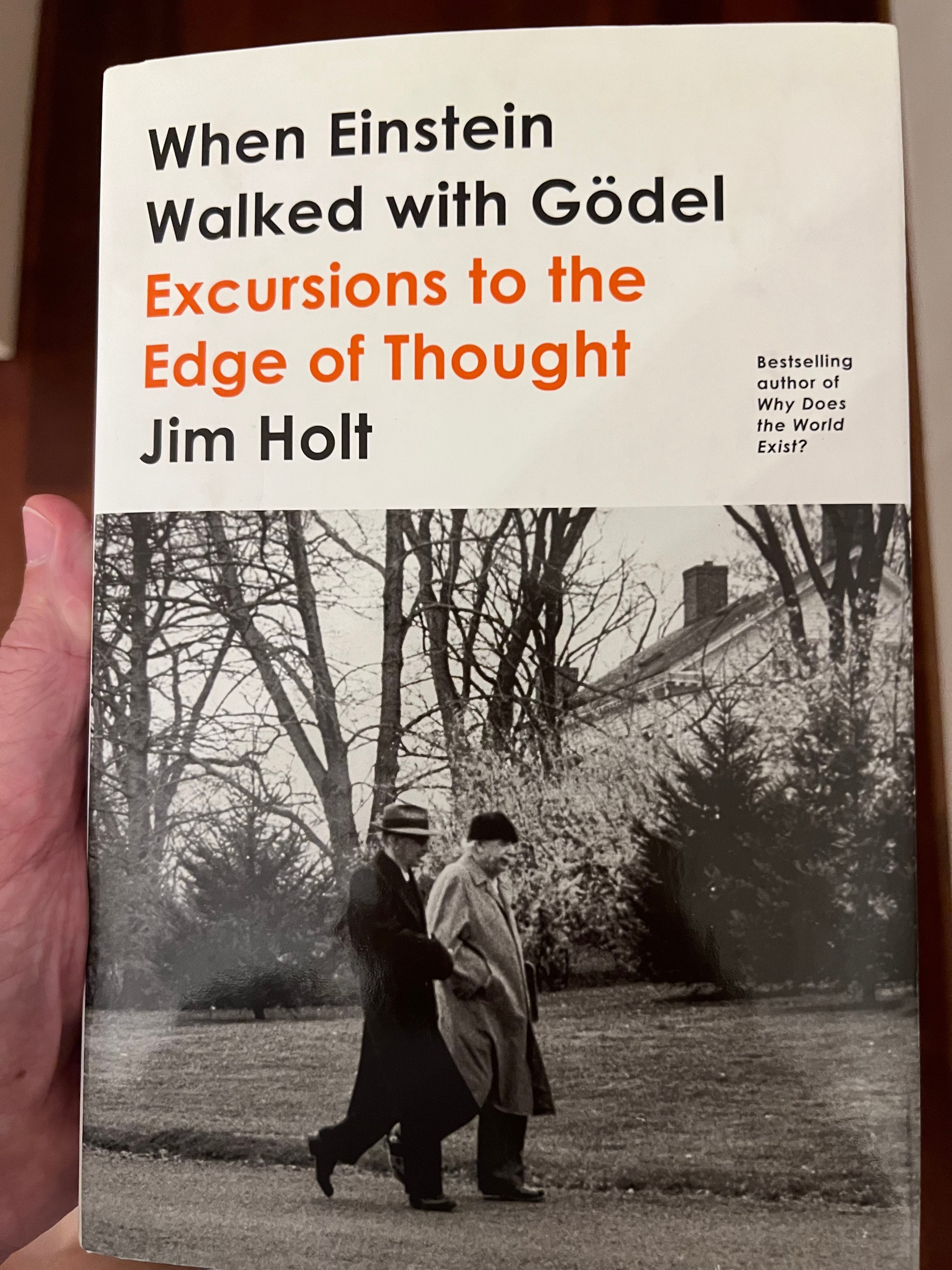
“What will civilization be like a million years from now? Most of the things we’re familiar with today will have disappeared. But some things will survive. And we can be pretty confident that among them will be numbers and laughter.” ~ Jim Holt
I closed When Einstein Walked with Gödel with the physical sensation that my own thinking had been upgraded. Not expanded in some hazy spiritual sense, but sharpened, energized, made more daring. Jim Holt’s essays do not ask us to admire genius from a polite distance. They invite us into the working lives of ideas, where audacity, error, stubbornness, and joy all coexist. For the first pages, there is no need for figurative language at all. What Holt offers is already sufficient. He gives us human beings who pushed thought further than it had ever gone, often at great personal cost, and he shows us how their work continues to matter.
Platonism
The central claim of this book is quietly radical. It is that the deepest discoveries in mathematics and physics are not cold abstractions, but acts of human courage. Holt writes about Albert Einstein and Kurt Gödel not as icons, but as walkers, talkers, companions. Einstein, near the end of his life, said he went to his office “just to have the privilege of walking home with Kurt Gödel.” That sentence alone reframes intellectual history. Discovery here is not a solitary flash but a shared persistence, sustained through conversation and mutual respect. What bound them was not merely brilliance, but a shared philosophical conviction that had left both men increasingly isolated. As Holt makes clear, Einstein and Gödel were united by their Platonism: the belief that the world is rationally organized and exists independently of our minds. In an era drifting toward indeterminacy in physics and formalism in logic, this faith in an objective, intelligible reality set them apart. Gödel was, Holt notes, “the only one of our colleagues who walked and talked on equal terms with Einstein,” not because he deferred, but because he shared the same stubborn allegiance to a universe that could still, in principle, be understood
As the essays unfold, Holt makes a compelling case that progress in human understanding does not move in straight lines. Einstein’s 1905 work dismantled the idea of universal time, an idea so ingrained that even Newton treated it as beyond dispute. Gödel then pushed further, using Einstein’s own equations to show that time itself might fail to exist in any fundamental sense. Holt recounts Gödel’s rotating universe, where a sufficiently long journey allows a return to one’s own past. Einstein admitted he was “disturbed” by this result. Disturbed is the right word. This is not triumphalist science. It is discovery that forces discomfort, revision, humility.
Heart-stopping beauty
Yet Holt refuses despair. Again and again, he insists that these unsettling results are also victories for the human mind. Gödel’s incompleteness theorems, so often framed as limits on knowledge, are presented instead as proof of intellectual abundance. No formal system can capture all mathematical truth, not because truth is small, but because it is larger than any single framework. Holt quotes Rebecca Goldstein’s description of Gödel’s proof as possessing “heart-stopping beauty,” and the phrase is earned. What could have been a story about failure becomes an argument for the irreducibility of insight itself.
One of the book’s most uplifting threads appears in Holt’s exploration of the number sense. Through the work of Stanislas Dehaene, Holt shows that humans are born with a primitive but real grasp of quantity. Even infants and animals share it. Mathematics, in this telling, is not an alien imposition but a cultural refinement of something already present in us. Holt describes a brain-damaged patient who cannot calculate exactly yet still knows that eight is larger than seven. Dehaene asked him to add 2 and 2 several times and received answers ranging from 3 to 5. But, he noted, “he never offers a result as absurd as 9.” That detail made me laugh out loud. Not because it is trivial, but because it reveals a quiet competence beneath the damage. The mind, even wounded, retains structure and judgment. That is a hopeful message for education, for rehabilitation, and for any society tempted to confuse difficulty with incapacity.
Holt’s prose has a rare generosity. He does not flatten disagreement or sanitize controversy. When physicists argue about time, when mathematicians disagree about realism, when philosophers accuse one another of confusion, Holt lets the conflict stand. He trusts the reader. He even trusts humor. John Archibald Wheeler’s line, discovered on a men’s room wall, that “Time is nature’s way to keep everything from happening all at once,” appears not as a joke at the expense of science, but as evidence that insight can surface anywhere thinking remains alive.
What ultimately distinguishes this book is its ethical confidence. Holt never claims that science guarantees moral progress. In fact, he shows how easily brilliance can coexist with blindness. Yet the overall argument is unmistakably affirmative. To pursue truth, even when it unsettles our most cherished assumptions, is a human good. To walk and argue and refuse complacency is a form of civic contribution. Holt reminds us that ideas are not luxuries. They shape how we live, teach, vote, and imagine the future.
By the final pages, I felt an unmistakable gratitude. Not just toward Einstein or Gödel or Dehaene, but toward the practice of thinking itself. Holt’s essays succeed because they do more than explain. They restore confidence that curiosity is not naive, that difficulty is not a defect, and that progress remains possible when we accept complexity without fear. Reading this book, I did not feel smaller in the presence of genius. I felt invited.
Stay curious
Colin
Dear Colin - THANK YOU SO MUCH!
I find your posts truly inspiring - especially this one: You continually motivate and encourage me to read and learn more = as well as THINK more!!
I will definitely try to take the time to read this whole book - after reading your post today! Even though these areas of physics & mathematics are NOT in my deep knowledge - I will persist with finding & reading this book!!
This book review does resonate with my special education background - also - especially that mathematics description of addition - and the points about failures or errors NOT being defects!
Thanks so much for allowing me to have this free subscription of your posts (& thinking)! This generosity is truly appreciated! 👍👍😊
I cherish this perspective that “to refuse complacency is a form of civic contribution”.
If we do not dialogue in curiosity about the “why”, then the “what” stands alone untested and unsupported by rigor. It is imperative to open the door of wonder to see what is, and also what perhaps has been missed, that conflates with the approbation “this is a fact”. However, there may be more to consider….new evidence is possible.