
Thinking Outside the Cultural Box
If Culture Shapes the Way We Think Can We Embrace World Views?

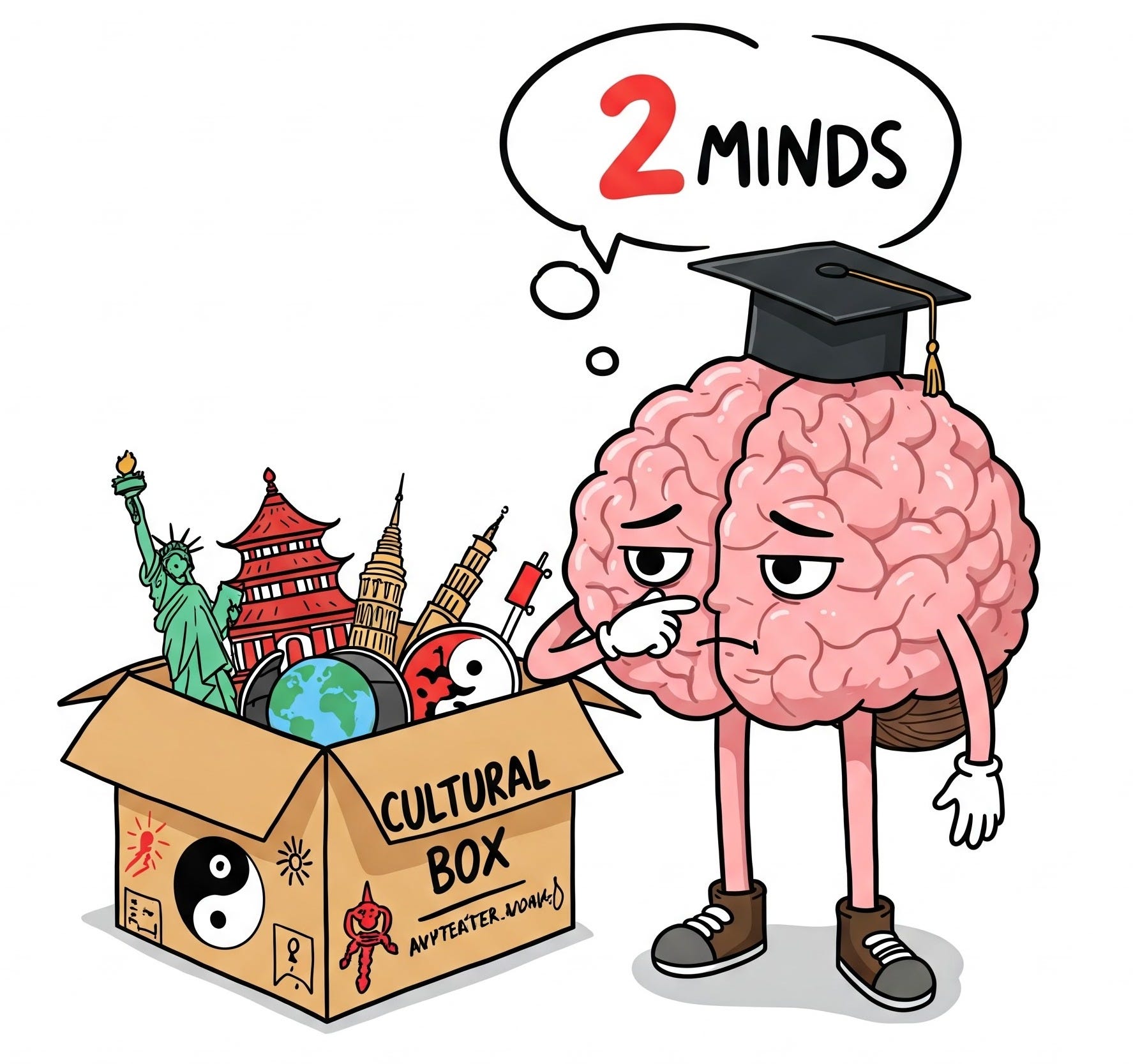
To think is to be human, but to think in a particular way is to be cultural.
I was just grading students AI work projects, whilst reviewing their submissions, I was struck by the diversity of thought. These students come from China, Japan, Saudi Arabia, Canada, the US and Europe (Spain, Poland, Holland, UK, Germany and Ireland). We might imagine that cognition is a universal constant, a pure, neutral faculty, untainted by the milieu in which it operates, but such an assumption would be as naïve as it is misguided. As Richard E. Nisbett reminds us,
“The most important lesson of cultural psychology is that mind and culture are inseparable.”
At the unification of modern Italy in 1860, Mazzimo d’Azeglio famously remarked, “Italy has been made; now it remains to make Italians.” Italian elites then implemented a range of policies to create a national identity, including enforcing a national language (Tuscan was chosen) and introducing compulsory schooling. The author of the 1877 Italian compulsory schooling reform stated that the aim of compulsory schooling was to “create a population... devoted to the fatherland and the king.”
The evidence is overwhelming: how we reason, how we infer, how we categorize and judge, and even how we conceive of contradiction are all shaped, shaded, and sculpted by the cultural waters in which we swim.
Two Schools of Thinking
If you examine the grand divide between analytic and dialectical thinking, two cognitive orientations that reveal not merely a difference in problem-solving techniques but an entirely distinct architecture of the mind. Richard Nisbett encapsulates this distinction:
“The holistic mind sees the forest, while the analytic mind sees the trees.”
The analytic thinker, shaped by Western traditions steeped in Aristotelian logic, the scientific method, the Church, and the Enlightenment’s thirst for categorization, sees the world as a collection of discrete, independently existing objects. Things have essences; rules are rules; contradictions demand resolution. It is this worldview that gave us Newtonian physics, legal codes built on precedent, and a devotion to the sanctity of the individual.
Contrast this with dialectical thinking, a mode more prevalent in East Asian societies, which treats objects not as self-contained entities but as interconnected elements within a broader, ever-shifting tapestry. As Kaiping Peng and Richard Nisbett put it,
“Western philosophy, particularly in its logical tradition, has aimed at eliminating contradictions, while Eastern philosophy has often embraced them.”
Change is expected, even cyclical. Contradictions do not present an obstacle to be demolished but an interplay of opposing forces seeking equilibrium. A rising stock may fall tomorrow; a misfortune today might be the first stirrings of good fortune yet unseen. One might recall the ancient Daoist imagery of yin and yang, not as opposing forces in a battle for supremacy but as interdependent principles, each seeding the other’s emergence.
The manifestations of these cognitive styles are abundant in everyday life. In business, Western corporations often focus on clear, linear objectives, quarterly growth, efficiency metrics, competitive dominance. In contrast, Japanese and Chinese business models tend to emphasize long-term relationships, adaptability, and harmony within the market ecosystem. Toyota’s just-in-time manufacturing philosophy, for instance, is an exemplar of dialectical thinking, responding fluidly to fluctuations rather than imposing rigid efficiency models. Similarly, the approach to medicine diverges: Western healthcare prioritizes precise diagnoses and targeted treatments, while Eastern traditions, such as traditional Chinese medicine, view health as a balance of interconnected systems.
Neither approach is inherently superior, but each excels in different contexts, as shown by the Nobel Prize in Medicine winner Youyou Tu who was honored for discovering the anti-malaria drug artemisinin, using Chinese medical texts from the Zhou, Qing, and Han Dynasties to find a traditional cure for malaria. She was the first mainland Chinese scientist to win the Nobel Prize. Her traditional medicine has saved millions of lives.
Of course, cognitive styles do not exist as monoliths within their respective cultures. Individuals within any given society exhibit a range of cognitive styles, shaped by education, personal experiences, and social influences. I have lived on 3 continents and adopted cultural thinking from each of those, as Danny Kahneman observed, “Thinking is an art, and like all arts, it requires practice and exposure to different methods.”
The research findings that describe our broad cultural and thinking tendencies should not be mistaken for rigid cultural determinism. There are analytic thinkers in China, just as there are dialectical thinkers in the United States. Cognitive diversity exists within cultures just as much as between them, and general trends should not obscure the richness of individual variation.
Cultural Quirks
Our thoughts and language, as Wittgenstein and many others have shown, shape perception at its most fundamental level. Alva Noë captures this beautifully:
“Perception is not something that happens to us, or in us. It is something we do.”
In studies comparing Americans and Japanese participants, researchers found that Westerners fixate on focal objects in a visual scene, attending to the fish in the foreground, while their East Asian counterparts absorb the background, the water, the entire relational context. The world is not an assembly of atomized units but a web of influences. Likewise, when asked to predict the future, Westerners tend to project linear continuity, AI is a good case in point where despite almost US$ 1 trillion in investment and numerous discourse, there are still many who think AI will not have much impact on their work, while East Asians are more inclined to anticipate reversal, embracing a world in flux.
We might dismiss these differences as quaint cultural quirks were it not for their profound consequences. Hazel Markus and Shinobu Kitayama draw a striking comparison:
“The self in Western culture is like a rock, individual and distinct. In East Asian cultures, it is like water, shaped by the container of relationships.”
Wittgenstein, the philosopher who revolutionized our understanding of language, insisted that meaning is rooted in language use, that context and ordinary language shape our perception of reality. Westerners are notoriously susceptible to the ‘fundamental attribution error’, the tendency to ascribe behavior to internal traits rather than external circumstances. When a man trips on the sidewalk, a Westerner is likely to smirk and think, ‘What a klutz for not paying attention!’ A Chinese observer, by contrast, is more likely to examine the context: Was the pavement uneven? Was he in a hurry? The analytic tendency to strip away context can be invaluable for isolating causal mechanisms in science but perilous in understanding human behavior.
Opposing Ideas
It is easy, too easy, to declare one mode of thought superior to the other. But as Confucius wisely reminds us,
“The wise man is one who, knowing the limits of his knowledge, seeks understanding beyond his own perspective.”
Western analytic reasoning has undeniably fueled scientific progress, legal systems, and technological revolutions. But dialectical thinking, with its emphasis on harmony, change, and context, offers its own cognitive arsenal, one particularly well-suited for navigating complexity and uncertainty. F. Scott Fitzgerald captured this intellectual agility when he wrote,
“The test of a first-rate intelligence is the ability to hold two opposed ideas in mind at the same time and still retain the ability to function.”
And so we return to the essential question: should we choose or stay in our closeted cultural thinking? Must we embrace one mode of thought to the exclusion of the other? The answer is both obvious and radical: we should cultivate both. Howard Gardner provides the most succinct rationale:
“There are two kinds of intelligence: the sharp analytic mind that dissects problems, and the fluid intelligence that connects seemingly unrelated ideas.”
Science needs the analytic precision of Western thought, but it also benefits from the holistic awareness of Eastern traditions. The challenge, then, is how to create a synthesis, an integration that draws from the strengths of both traditions.
This synthesis is not merely theoretical but deeply practical. One way to cultivate both modes of thought is through deliberate exposure to different frameworks, learning a second language, engaging with literature or philosophy from a different tradition, or even training oneself to ask better questions, “Why?” and “How?” when approaching a problem.
Analyzing the Mundane
I’ve spent countless hours captivated by the mundane, yet insightful every day observations in Nicholson Baker’s The Mezzanine. In essence it is a novel that masquerades as an ordinary day, yet within its pages lies a profound meditation on the unnoticed rhythms of modern life. It is a book about a man, Howie, on his lunch break, riding an escalator, doing chores, sitting on a park bench, and reflecting on the minutiae of existence with ‘fierce attention to detail.’
In one section Baker elaborates on his thoughts about shoelaces breaking in rapid succession (I told you it had mundane details, but are they really?) Baker’s breaking shoelaces are not just an anecdote, it’s an inquiry into wear and tear, into synchronicity, into the unseen logic of small failures. One lace snaps, and then, improbably, so does the other, within days. Is this an accident? Or does daily habit, the identical motions of tying and untying, create an inevitable failure rate? Baker laments:
“I pulled the left shoelace tight, and bingo, it broke. The curve of incredulousness and resignation I rode out at that moment was a kind caused in life by a certain class of events, disruptions of physical routines.”
Baker’s mind doesn’t stop at the observation; it builds a forensic case, considering friction, pressure points, microscopic unravelings. What starts as a broken shoelace turns into an exploration of entropy and routine, a study of time itself as measured in the frayed fibers of daily existence. He discovers a Polish scientist, Z. Czaplicki, who he imagines might have dedicated his career to studying shoelace degradation, laughing at the absurdity while marveling at the precision with which the mundane can be dissected. When he discovers Czaplicki’s paper “Research on Footwear Laces with Respect to Abrasion Resistance and Spontaneous Untying”, he is overcome with joy: “I let out a small cry and slapped my hand down on the page.”
Education systems that blend structured logic with flexible inquiry help nurture both styles of reasoning. Organizations that incorporate both top-down analytical strategies and bottom-up holistic adaptability thrive in unpredictable environments. The key is to avoid rigid allegiance to one mode while embracing the strengths of both.
Superforecasting
More than just a theoretical exercise, this fusion of thinking styles has direct applications in everyday life. Decision-making benefits from recognizing when to apply analytic precision versus when to adopt a more dialectical, context-sensitive approach. Conflict resolution improves when we learn to integrate rather than polarize perspectives. Adaptability increases when we acknowledge that change is often cyclical rather than linear. Even our ability to learn and innovate strengthens when we bridge these modes of thought rather than treating them as opposing forces. Above all learn the skill of a superforecaster.
The greatest minds, after all, have always been those who could think beyond the boundaries of their own culture. Einstein, though immersed in the Western analytic tradition, mused on paradox and relativity in ways that would not have been foreign to a Daoist sage, as did Oppenheimer. The great strategist Sun Tzu, though a product of the East, employed systematic logic in a way that would make a Western tactician proud. Wisdom, in the end, is not about choosing sides but about expanding the range of one’s vision.
It is in the bridging of perspectives, the harmonizing of contradictions, that true understanding, and perhaps true intelligence, is found.
Stay curious
Colin
Image created with Google Gemini Imagen 3
This is incredible, Colin! So much resonance here. So many paragraphs I could quote. I'm reading this as if you are providing a theoretical framework for Synchronosophy... the differences between Eastern and Western cultures (I grew up in between both) the story of Baker's mind and building a forensic case around a mundane event... “Perception is not something that happens to us, or in us. It is something we do.”... Thinking beyond the boundaries of one's own culture ( or current state of mind) ... "Wisdom, in the end, is not about choosing sides but about expanding the range of one’s vision." Indeed!
I'll need to read it again 💙 🙏
Embracing cultural diversity enriches the world within and around us, from the mythology of origins, religion/philosophy, to food, literature and the arts. We have seen what happens when culture was rejected and homogenized under Maoist China and we are heading that way here in the US, where white/right Christian values are being pushed at the expense of all others. Like a good sourdough starter, cultures are living, breathing entities which need to be nurtured and fed, not constricted and starved. In other words, traditions should be adhered to by some, broken by others but nurtured by all, both within the culture and outwith. I did not enjoy my education growing up in the UK, but one of the biggest, most mind-bending moments for me was during my first 'scripture' class at public school when I was handed a copy of The World Bible and all of sudden my mind expanded and opened up before my eyes as I turned the pages. It opened my mind to everything else outside of my narrow existence. In my experience, the mind which embraces the myriad manifestations around it will understand The Constant Way more easily and more readily, or as a wise friend of mine once said, "The mind is like a parachute, it works best when it's open."