
Unfulfilled Potential
A Reflection on Time, Impact, and the Grand Illusion of Personal Progress

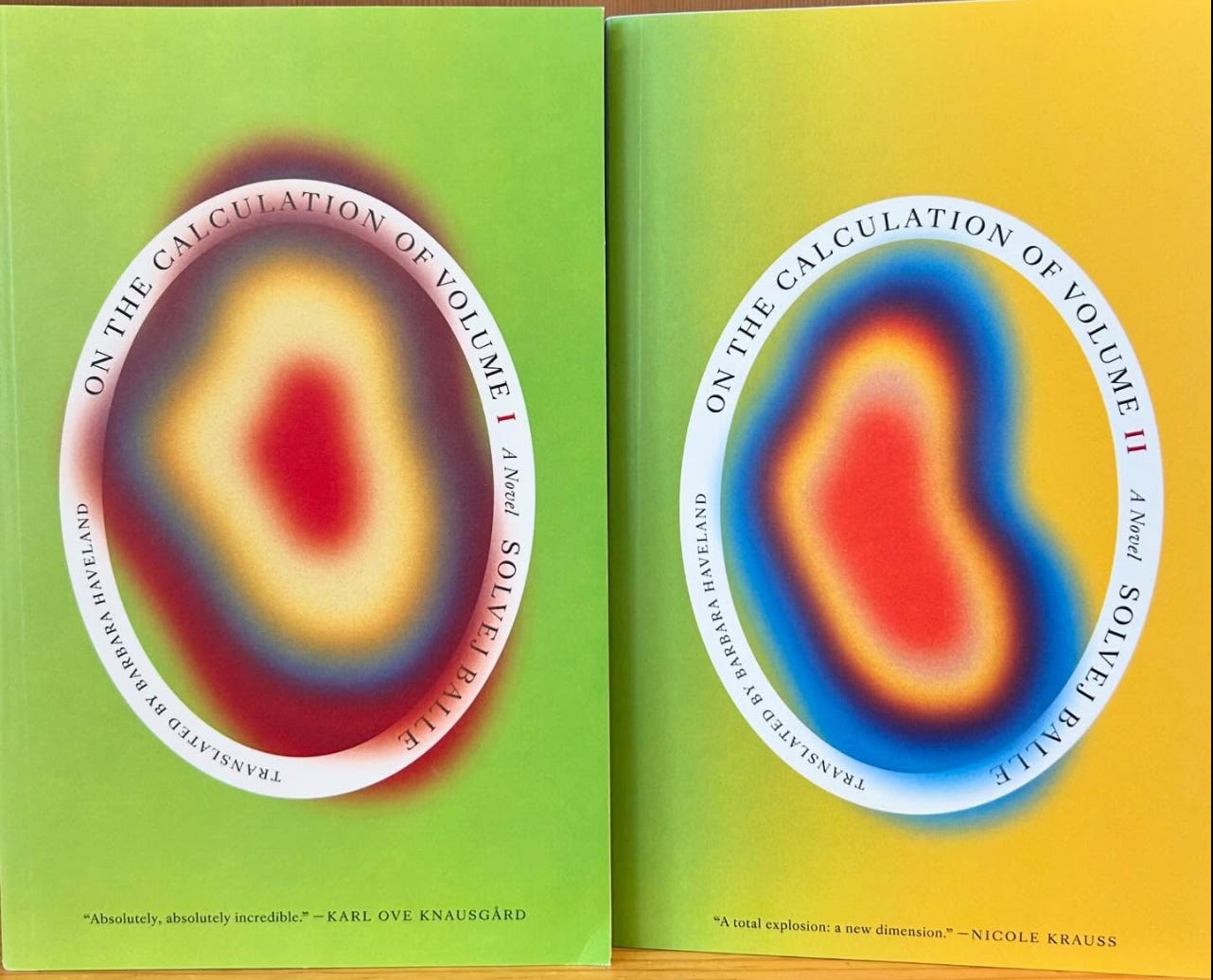
Each morning, we rise to the same sun, walk the same streets, mutter the same excuses, as if condemned to live out an eternal déjà vu. We vow to change, to grow, to seize the moment, yet the moment, ever elusive, slips between our fingers like sand in an hourglass that resets itself at dawn. Although not as explicit, this is the message and the essence I took from my reading of Solvej Balle’s On the Calculation of Volume I and II, a brilliant, yet disquieting, intellectual riddle wrapped in the ordinariness of existence, a haunting reflection of our own entrapment in the recursive loop of ambition and inertia. Balle writes
We “dwell in the halls of folly,” and “surrender to the gentle grip of apathy.”
Balle’s protagonist, Tara Selter, a rare-book dealer in France, swept up in the absurdity of living the same day again and again, is no mere play on the existential horror of time’s circular nature, rather, it is a reckoning with the stasis we impose upon ourselves. Through the meticulous precision of her prose, Balle constructs an experience where the weight of time accumulates rather than dissipates. The protagonist does not merely endure repetition, she measures it, interrogates it. “The day repeats itself,” she observes, “but the weight of it shifts.” This subtle evolution within the static captures the essence of how we, too, experience time, not as a blank slate each day, but as a palimpsest upon which our past hesitations, mistakes, and learned fears are etched.
The structure of Balle’s novel mirrors this cyclical entrapment. The repetition in language, the careful return to the same phrases, forces the reader into a rhythm as oppressive as it is revelatory. The narrative becomes both claustrophobic and illuminating, demonstrating how our habits, our decisions, and our failures shape the boundaries of what we perceive as possible. Through this, Balle does not merely tell us about stasis, she makes us feel it.
Personal Stagnation
This book made me think deeply about my own path.
Why do we not change? Why do we not meet our full potential? The question lingers like the smell of old books, thick with the dust of past failures. History, that grand testament to our collective amnesia, shows how civilizations rise and fall, how revolutions begin with feverish promise and end in bureaucratic lethargy. The French Revolution, so full of incendiary rhetoric, "liberté, égalité, fraternité!" spiraled into the tyranny of the guillotine. The Russian Revolution, armed with manifestos and proletarian hope, gave birth to an empire of paranoia and purges. The march of progress is a circular parade, each era marching forward only to loop back to the same fundamental struggles. If you kept a note of your daily life, would it be part prison diary or a grand statement?
Balle, like Borges before her, forces us to contend with time as something other than linear. This is not a story of mere redundancy, but of how we endure the repetition of our own failings, the gravitational pull of our past decisions dragging us toward their inevitable replication. A partner leaves, a career stalls, a promise fades, not out of cosmic malice or lack of free will, but because we have failed to grasp the machinery of consequence, the gears that lock us into the predictable patterns of our own making.
Think of Sisyphus, that tragic Greek figure condemned to push a boulder up a hill only to watch it roll back down for eternity. We are no different. We hustle, we network, we build careers and reputations, yet how often does any of it break the cycle? The sheer mass of systemic inertia, the politics of power, the economics of exploitation, the psychology of self-doubt, ensures that our best efforts dissipate into a void that does not yield.
Breaking Free from the Loop
There is a deceptive comfort in the cycle, a soothing rhythm to failure repeated in familiar ways. How many meetings are held to discuss change only for those meetings to lead to more meetings? How many resolutions, drafted in the fevered hope of transformation, dissolve in the slow, insidious return to habit? The structures we exist within are self-replicating, feeding upon our optimism, digesting our best efforts into nothing more than administrative journal notes of what might have been.
Yet, there is something subversive in Balle’s work, a whisper of rebellion that lingers beneath the surface. If time can be rewritten, so too can fate. The tragedy of the cycle is not its inevitability, but our failure to notice its seams, the moments where a shift, however small, the eye of a needle, might allow us to slip through the barriers we assume are immutable. Perhaps the way forward is not through grand, sweeping revolutions, but through the imperceptible defiance of refusing to let routine define us. Just as innovation is incremental, so too is our ability to shed the bad habits that bind us.
The great thinkers of history, Nietzsche, Camus, Arendt, grappled with this same specter of repetition. Nietzsche, with his eternal recurrence, dared us to ask whether we could live our lives over and over again and still find joy. Camus, in his contemplation of Sisyphus, suggested that perhaps the true act of rebellion is in smiling despite the burden. Arendt warned that the banality of evil lay not in monstrous acts, but in the slow, bureaucratic normalization of cruelty and inaction. Each, in their own way, challenged the fundamental assumption that we are bound to repeat ourselves.
Balle leaves us with no easy answers, only the slow-burning realization that change is possible, but only if we dismantle the illusion of inevitability. The protagonist of On the Calculation of Volume does not rage against the cycle, nor does she accept it, she studies it, measures it, recalculates it. She resists by understanding. And perhaps that is the first step out of our own loops, to recognize the patterns, to dissect them, and, when the moment presents itself, to finally, truly, break free. But what then? To escape the cycle is one thing. To shape what comes after is another challenge altogether, one that demands not just awareness, but a radical willingness to act.
Stay curious
Colin
Thank you for the book summary. I have found that it is relatively easy to 'drop out' of The System, but not so easy to 'drop back in' in a meaningful way and on one's own authentic terms.