
What I Have Been Reading
A walk with humility

"The unprepared mind cannot see the outstretched hand of opportunity." ~ author unknown
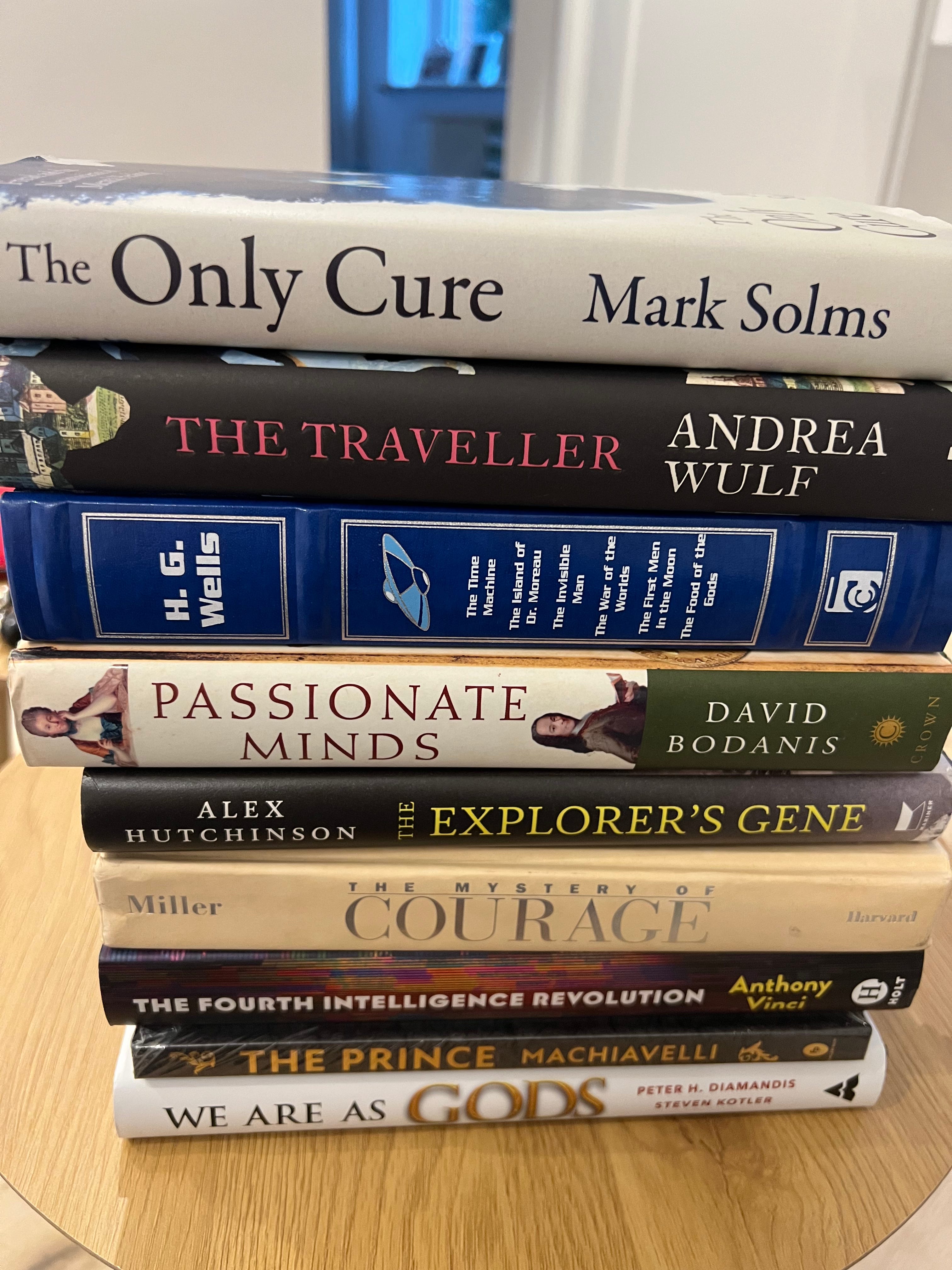
Lately I have been reading books that seem, at first, to have little to do with one another. Napoleon and Wellington. Patrick Leigh Fermor walking from the Hook of Holland toward Constantinople. Freud and neuroscience. George Forster in search of humanity. Chekhov’s short stories. H. G. Wells’s scientific romances. Alexander Fleming and penicillin. A stonemason looking at great buildings through hand, eye, patience, and craft.
On the surface it is a strange shelf. Soldiers, walkers, analysts, explorers, doctors, storytellers, inventors, masons. Yet the more I read, the more the books begin to speak to the same question: what kind of person does the world require when the old certainties are gone?
This is the question that has been following me.
Lord Andrew Roberts’s Napoleon and Wellington is not simply a book about two military men. It is a study of temperament. Napoleon was speed, imagination, appetite, theatre, energy pushed beyond ordinary limits. Wellington was discipline, reserve, judgment, and the refusal to be overwhelmed by drama. Napoleon wanted to bend events to his will. Wellington wanted to survive events long enough to master them.
What interested me most was not the clash between them, but the contrast in their inner equipment. Napoleon had brilliance, but brilliance can become dangerous when it ceases to receive correction. Wellington had something less glamorous and perhaps more durable: self-command. He did not need the world to applaud him every hour. He could wait. He could observe. He could endure discomfort without turning it into a performance.
That is a rare quality. It is also one badly needed now.
We live in an age that rewards display. It rewards speed, reaction, certainty, and spectacle. Yet most of the things that endure are not built that way. A life is not built that way. A family is not built that way. A company is not built that way. A country is not built that way. Judgment grows slowly. Character grows slowly. The future belongs not to the loudest mind, but to the steadiest one.
The Walking Mind
From Napoleon and Wellington I went to Patrick Leigh Fermor, and the change of pace was almost physical. A Time of Gifts and The Broken Road are books of walking, but they are also books of attention. Fermor moves through Europe on foot, and because he is on foot he sees what faster people miss. Inns, languages, manners, ruins, weather, jokes, churches, rivers, faces, old families, young peasants, strange hospitality, fragments of empire, traces of a vanished Europe. The road teaches him because he is willing to submit to its pace.
A walking mind is different from a scrolling mind. A walking mind receives the world in sequence. It cannot jump instantly from village to empire, from weather to theory, from a face to an abstraction. It must pass through things. It must notice distance. It must earn arrival.
Fermor reminds me that education is not only reading books. It is also moving through the world with enough humility to be altered by it. He was not merely collecting impressions. He was being formed. Every road, conversation, hardship, and chance encounter widened him. His journey was not efficient. That is precisely why we should care.
Efficiency is not the highest human category. Some experiences should not be compressed. Friendship should not be compressed. Grief should not be compressed. Learning should not be compressed. Childhood should not be compressed. A walk across Europe cannot be reduced to its route. It becomes meaningful because of all the delays.
Then there is The Traveller, the life of George Forster. Forster interests me because he belongs to that eighteenth-century world in which travel, science, politics, and moral imagination still touched one another. He was not just seeing new places. He was trying to understand humanity. That is a larger ambition than discovery. Discovery can become possession. Understanding requires sympathy.
Forster’s life reminds me that travel is morally dangerous if it becomes only acquisition: names, species, specimens, observations, status. But it can also become an education in humility. To meet other peoples seriously is to lose the right to think cheaply about human beings. The world is too large, too varied, too inventive, and too wounded for easy categories.
This is why Forster feels close to our own moment. We have more information about humanity than any generation before us, yet often less patience for human difference. We can summon images from every continent, but still fail to see the person in front of us. Forster’s search for humanity is not finished. It has merely changed instruments.
The Deeply Human Scene
The same concern appears in The Only Cure, which brings Freud into conversation with neuroscience and mental healing. Freud is unfashionable in many rooms, sometimes for good reasons. Yet the central question remains alive: how does a person become less divided against himself? How does suffering speak through the body, through memory, through repetition, through desire? How does talking help? Why does being heard matter?
Modern neuroscience gives us new language for old pain, mapping how circuits, plasticity, prediction, and memory respond to trauma. But the human scene remains intimate. A person sits with another person and tries to tell the truth. This is still astonishing. We are not machines that can simply be repaired by replacing a part. We are story-bearing creatures. We are shaped by what happened, what we feared happened, what we could not say, and what we learned to hide even from ourselves.
Healing, then, is not a technical fix. It is relational. It is not merely the removal of symptoms. It is the recovery of agency. To be healed is, in some measure, to be able to act again without being ruled by the unseen past.
This connects unexpectedly with Chekhov. I have been reading Fifty-Two Stories, and Chekhov has the strange power of making almost every theory of human life seem too large. He does not thunder. He does not announce. He notices. A clerk, a doctor, a wife, a schoolteacher, a peasant, a child, a tired official, a disappointed lover. Small rooms. Bad weather. Errand. Vanity. Tenderness. Boredom. Cruelty. Hope that does not quite know its own name.
Chekhov’s greatness lies in his refusal to force life into an argument. He lets people remain mixed. No one is only noble. No one is only ridiculous. Even weakness has a history. Even foolishness has a wound. He does not excuse people, but he does not flatten them either.
This is moral intelligence. It is also a discipline. To see people clearly without despising them is hard. To see oneself clearly without despair is harder still. Chekhov teaches both.
Consequences and Craft
Then I turned again to H. G. Wells: The Time Machine, The Island of Dr. Moreau, The Invisible Man, The War of the Worlds, The First Men in the Moon, The Food of the Gods. Wells is often treated as a prophet of technology, but that is too small. He is a prophet of consequences. His real subject is what happens when human power outruns human wisdom.
The machines and experiments in Wells are never just devices. They are tests of character. Time travel exposes complacency. Moreau’s island exposes cruelty dressed as science. Invisibility exposes the hunger to act without accountability. Martian invasion exposes the fragility of civilization. The moon exposes imperial absurdity. The food of the gods exposes growth without moral proportion.
Wells understood something that we are still struggling to admit: the future does not arrive as a neutral improvement. It arrives as a pressure placed upon the soul. New powers ask old questions with greater force. What are we? What do we owe one another? What must never be done, even if it can be done? Who benefits? Who is left out? Who pays?
This is why Wells feels so modern. The tools have changed, but the examination has not. Artificial intelligence, biotechnology, surveillance, synthetic media, automation, neurotechnology: each promises possibility. Each also asks whether our moral habits are strong enough for our technical reach.
Alexander Fleming’s life entered my reading shelf as a different kind of lesson. The discovery of penicillin is often told as a story of chance, but chance alone discovers nothing. Fleming noticed. That is the point. Many people pass by the important thing because it does not arrive looking important. Mold on a plate. An accident. A contamination. A small anomaly.
Science depends on prepared attention. It depends on the mind that does not merely see what it expected to see. Fleming’s greatness was not that the accident happened to him. Accidents happen constantly. His greatness was that he did not waste the accident.
There is a lesson here for research, business, writing, and life. The new often appears first as inconvenience. It interrupts the plan. It dirties the surface. It looks like failure. Most people clean it away. A few people stop and ask why.
That pause can change the world.
Finally, there is Monumental, the book by a stonemason looking at great buildings through the hands and eyes of craft. I loved the premise before I opened it. A building is not only an idea. It is weight, patience, error, correction, material, hand, weather, tool, fatigue, pride, and stewardship. The mason knows what the tourist misses. He knows that beauty is not merely seen. It is made.
There is something deeply moving about that. We live among surfaces and outputs. The stonemason returns us to process. A wall stands because someone learned how stone behaves. A cathedral rises because thousands of acts of discipline outlived the people who performed them. The hand disappears into the work, but the work remains.
This is the opposite of our age’s obsession with instant authorship. The mason does not ask to be congratulated every few minutes. The mason fits one stone properly, then another. The building becomes an argument for patience.
A Defense of Seriousness
Reading these books together has made me think that civilization depends on several endangered habits.
The first is attention. Fleming noticing the mold. Chekhov noticing the small sadness. Fermor noticing a village. The mason noticing stone. Without attention, there is no discovery, no art, no healing, no judgment.
The second is restraint. Wellington had it. Freud’s best heirs require it. A scientist needs it. A builder needs it. Wells warns us what happens when power loses it. Restraint is not weakness. It is strength that has accepted limits.
The third is sympathy. Forster searching for humanity. Chekhov refusing contempt. Fermor accepting hospitality. Healing requiring another person to listen. Sympathy is not sentimentality. It is disciplined recognition that the other person is real.
The fourth is craft. The mason’s hand, the writer’s sentence, the doctor’s observation, the traveller’s memory, the scientist’s experiment. Craft is the place where ideals become trustworthy. Anyone can praise excellence. Fewer people submit to the repetitions that produce it.
And the fifth is courage, but not the theatrical kind. I mean the quieter courage to keep learning, to be corrected, to endure ambiguity, to change one’s mind, to begin again after disappointment, to walk rather than rush, to notice rather than assume, to build rather than merely comment.
Perhaps that is what these books have been giving me: a defense of seriousness.
Not solemnity. Not heaviness. Seriousness. The kind that says life is short, attention is precious, and the world deserves more than our distraction. The kind that says knowledge is not decoration. It must change how we live. The kind that says power without character is dangerous, travel without humility is tourism, science without conscience is perilous, and beauty without labor is fantasy.
I began with a shelf of unrelated books. I ended with a single demand.
Pay attention.
Pay attention to the road under your feet. Pay attention to the person across the table. Pay attention to the accident in the laboratory. Pay attention to the sentence that reveals a life. Pay attention to the stone, the wound, the machine, the story, the temptation to hurry, the temptation to dominate, the temptation to simplify another human being.
These books are not asking me to admire the past. They are asking me to become more capable in the present.
That is why I read. Not to escape the world, but to return to it better equipped. With a slower eye. A steadier hand. A deeper patience. And, I hope, a larger humanity.
Stay curious
Colin
This is a few that have made deep impressions. Others I will write about soon.
Speaking of walking, this afternoon I got on the 6 train. After waiting for a proverbial eternity, an announcement was issued that all 4, 5 and 6 trains in both directions were delayed due to "signal problems".
So I blurted out some choice expletives, got off at 86th St. and walked down to 63rd St. to catch the F train back into Brooklyn. Needless to say, my dogs are barking at me.
I cannot find citation to a talk, paper, or book by Fleming for this quote. It seems derivative and perhaps a corruption of Pasteur's "Dans les champs de l'observation le hasard ne favorise que les esprits préparés" (In the fields of observation, chance favors only the prepared mind) in an 1854 lecture at the University of Lille. https://en.wikiquote.org/wiki/Louis_Pasteur